mardi 27 septembre 2011

REPORT: Longest Facebook Sessions Are In Singapore

Facebook users in Singapore spend the most time on the social network each time they begin a session, while those in Brazil tend to hang around for much shorter times, according to the latest international study on the use of social networks from Experian.
The U.K. research firm examined social network usage in eight countries. The average time per Facebook session ended up as follows:

  • Singapore: 38 minutes, 46 seconds;
  • New Zealand: 30:31;
  • Australia: 26:27;
  • United Kingdom: 25:33;
  • France: 21:53;
  • United States: 20:46;
  • India: 20:21; and
  • Brazil: 18:19.
However, Brazil performed strongly when the same eight countries were analyzed in terms of percentage of Internet visits going to social networking sites, while the opposite was true for the United Kingdom:
  • Brazil: 18.9 percent;
  • Singapore: 16.4 percent;
  • United States: 15.4 percent;
  • France: 15.1 percent;
  • India: 14 percent;
  • New Zealand: 13.9 percent;
  • Australia: 13.1 percent; and
  • United Kingdom: 12.2 percent.
Other Facebook-related findings from the Experian study:
  • Facebook is cutting into Orkut’s lead in Brazil. The latter still tops that country in terms of social network market share, at 43 percent, but Facebook picked up 16 percent from August 2010 through August 2011.
  • India was the country with the most explosive Facebook growth from August 2010 through August 2011, with the social network posting an 88 percent market-share increase.
  • Facebook’s market-share increase in the United States for the same period was five percent.
Readers: Approximately how much time do you think you spend during each Facebook session?

lundi 26 septembre 2011

Oracle to debut Sparc server with new T4 chips

A Sparc-based SuperCluster from Oracle 
Oracle Chief Executive Larry Ellison made his fortune with software, but he'll take the stage today to show off the first servers powered by the company's new Sparc T4 processor.
The product, called the Sparc SuperCluster T4-4, is "the first engineered system from a new generation of high-performance Oracle Sparc servers," according to an Oracle invitation to the event . Ellison will share the stage with John Fowler, the systems executive vice president who also led Sun's server group, at Oracle's Redwood Shores, Calif., headquarters.
Oracle acquired Sun Microsystems last year for its server products, including the Sparc processor family and the Solaris version of the Unix operating system. Oracle plans to marry the Sun technology with its own server software for business tasks such as ruining databases of information, managing finance and accounting, and handling customer relations. Clusters link multiple servers in a design geared to accommodate heavier work without the expense of a single server with a higher processor count.
When Oracle was just a software company, it relied on tight ties with hardware makers. Now, though, it's willing to irk erstwhile partners, for example by declaring Intel's Itanium processor dead, ceasing software development for it, and thereby denting HP Itanium server sales.
Oracle's Sparc processors, along with Sparc64 models from ally Fujitsu, compete in the server market with Itanium and IBM's Power family. But x86 chips from Intel and to a lesser extent AMD occupy an ever-larger swath of the server market. Those x86 processors are gradually gaining high-end features once reserved for the server processors that have higher reliability requirements.
Sun's T-series processors began with the T1 "Niagara," evolved to the T2 "Victoria Falls" and T3 "Rainbow Falls." All three of those designs emphasized the ability to perform lots of parallel tasks at once at the expense of executing an individual task as quickly as possible. Not only did the T-series processors push hard with multiple processing engines, called cores, on the same same slice of silicon, they also pushed hard by letting each core executive multiple instruction sequences, called threads.
With the T4, though, Oracle is headed in a more traditional direction: fewer processor cores running at a faster clock speed, according to details the company shared at the Hot Chips conference in August.
"The new Sparc T4 design illustrates the ongoing struggle of processor designers to balance single-thread performance versus throughput on highly threaded code," Linley Group analyst Bob Wheeler. "Reversing Sun's prior direction of increasing the number of threads per processor, Sparc T4 instead prioritizes greater single-thread performance over throughput.The result is a processor with eight CPUs operating at 3.0GHz compared with the T3's 16 CPUs operating at a lowly 1.65GHz."
Each T4 processor core, called S3, can juggle between eight threads. Thus, the overall chip can handle 64 threads.

Google+ users up 30 percent since going public?

After opening its doors to the public last Tuesday, Google+ may now have more than as 43 million users.
So says Ancestry.com co-founder and Google+ unofficial statistician Paul Allen, who's been keeping a running tally of how big the social network is growing.


Compiling his regular series of stats based on surnames used around the world, Allen said last Thursday that Google+ witnessed a 30 percent jump in users in the two days following its official opening to all users on September 20.
In just those two days, the growth rate skyrocketed to that only seen during the first week of the network's "field test" in late June, according to Allen, who's unrelated to the Microsoft co-founder of the same name.
Projecting the figures over the past few weeks, Allen's model came up with 28.7 million users on September 9. Last Thursday morning, that number had swelled to 37.8 million, with most of the growth coming from the prior two days. And accounting for a fudge factor and other elements, he came up with an estimate as of last Thursday of 43.4 million users.
Over the past couple of months, Allen has been busy projecting the ongoing growth of the social network. From 1.7 million users on July 4, about a week after Google+ kicked off, Allen's estimate rose to 4.5 million on July 9, 10 million on July 12, and 18 million on July 20.
Google itself has generally been mum about user counts as its social network has grown, though it did cite 10 million users on July 14, not too far off from Allen's projection at the time.
In response to the latest user estimates, a Google representative told CNET that the company isn't commenting on Allen's statistics and that it hasn't announced any new metrics since July 14.
Despite the ongoing growth in overall users for Google+, a report from Experian Hitwise earlier this month claimed that the number of weekly visits to the service has been dropping since mid-July.

Facebook unfriending 'bug' gets quick fix

Facebook users who were spying on their Timeline to see who had unfriended them in the past will no longer be able to do so.
Late last week, Facebook users discovered that when accessing the social network's new Timeline feature and choosing a year, they could find out which former friends had unfriended them. When viewing their friends list in a particular year, users who saw an "Add Friend" icon next to a person's name knew that that particular user had unfriended them since that time.
As expected, folks who have access to Timeline rushed to the new feature to see who had decided against keeping in contact. Meanwhile, some privacy advocates complained that the feature was a violation of user privacy, since it was made abundantly clear to de-friended people who no longer wanted contact with them. After just a couple days of outcry, Facebook nixed the feature, telling some reporters it had been a bug.


Over the years, Facebook has shied away from allowing users to find out when they're unfriended by a person. That said, it isn't all that difficult to determine. If users sift through their friends list looking for someone who used to be there and now isn't, they're no longer a friend. And when they view that person's profile page, they'll be given the "Add Friend" option.
So, while the Timeline bug was by no means groundbreaking, it was notable, since it made it much easier for folks to determine who had unfriended them.
Timeline was announced last week during Facebook CEO Mark Zuckerberg's keynote address at the F8 conference. The feature, which will be rolled out to the entire Facebook community in the coming weeks, allows users to take a glimpse into their lives on the social network over the years by viewing updates they posted, friends they had, and other content shared with the site. During his address, Zuckerberg said Timeline is "the story of your life."
Facebook did not immediately respond to CNET's request for comment on the Timeline fix.

Apple slashes fourth-quarter iPad orders, report says

Did Apple slash iPad shipments in the fourth quarter?
(Credit: Apple)
Apple has cut iPad orders from manufacturing partners, Bloomberg is reporting, citing an investment report from JP Morgan Chase.
Apple has reportedly cut fourth-quarter iPad shipments by 25 percent, Bloomberg says, per JP Morgan Chase. The analysts at JP Morgan said that this is the first time they've seen Apple slash iPad shipments since the tablet launched last year.
If Apple has, in fact, cut iPad shipments for the fourth quarter, it will have a profound impact on many of its suppliers, including Hon Hai Precision. According to the analysts, Bloomberg says, Hon Hai was planning to ship 17 million iPads in the fourth quarter, but will now only ship 13 million units.


It's unclear why Apple might want to cut back on iPad shipments, if that is in fact what's happening. Perhaps it ordered too many iPads in previous quarters, or it's slowing down iPad 2 production to prepare for the eventual iPad 3, or there might be other supply chain management and spending issues involved.
What's more, even with those purportedly reduced shipments, analysts aren't ready to say that Apple will sell fewer iPads in the fourth quarter. According to Bloomberg, JP Morgan analyst Mark Moskowitz will maintain estimates that Apple will ship up to 12 million iPad units in that quarter, even with reduced orders to suppliers.
If Apple can keep up its momentum, and sell as many iPads as researchers expect, this could be another big year for the tablet. Last week, research firm Gartner reported that it expects Apple to sell nearly 47 million iPads this year, up from the 14.7 million it sold last year. Even more impressive, Gartner believes Apple will ship nearly 149 million iPads in 2015.
Apple did not immediately respond to CNET's request for comment on the Bloomberg report.

samedi 24 septembre 2011

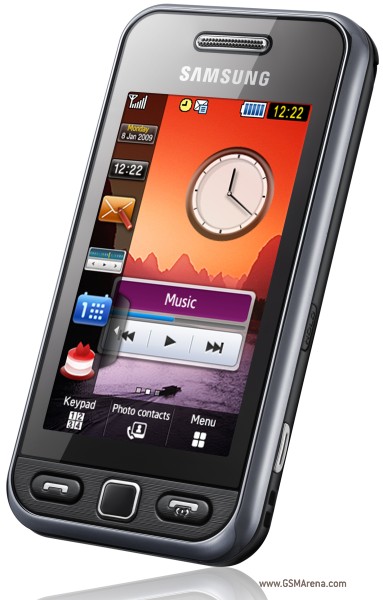
Samsung S5230W Star WiFi


General 2G Network GSM 850 / 900 / 1800 / 1900
Announced 2009, September
Status Available. Released 2009, September


Size Dimensions 104 x 53 x 11.9 mm
Weight 92 g
Display Type TFT resistive touchscreen, 256K colors
Size 240 x 400 pixels, 3.0 inches (~155 ppi pixel density)
- Accelerometer sensor
- Handwriting recognition
- Smart unlock
Sound Alert types Vibration; Downloadable polyphonic, MP3, WAV ringtones
Loudspeaker Yes
3.5mm jack No
- DNSe (Digital Natural Sound Engine)
Memory Phonebook Yes, Photo Contact
Call records Yes
Internal 50 MB
Card slot microSD, up to 16GB (verified), buy memory
Data GPRS Class 12 (4+1/3+2/2+3/1+4 slots), 32 - 48 kbps
EDGE Class 12
3G No
WLAN Wi-Fi 802.11 b/g
Bluetooth Yes, v2.1 with A2DP
Infrared port No
USB Yes, v2.0
Camera Primary 3.15 MP, 2048x1536 pixels
Features Smile detection
Video Yes, QVGA@15fps
Secondary No
Features Messaging SMS, MMS, Email
Browser WAP 2.0/xHTML, HTML
Radio Stereo FM radio with RDS
Games Yes + downloadable
Colors Black, Silver, White, Pink
GPS No
Java Yes, MIDP 2.0
- MP3/WMA/AAC player
- H.263/H.264/MP4 player
- Organizer
- Document viewer (Word, Excel, PowerPoint, PDF)
- Shazam Find Music service
Battery Standard battery, Li-Ion 1000 mAh
Stand-by Up to 700 h
Talk time Up to 10 h
Misc SAR US 0.75 W/kg (head)     0.65 W/kg (body)    
SAR EU 0.59 W/kg (head)    

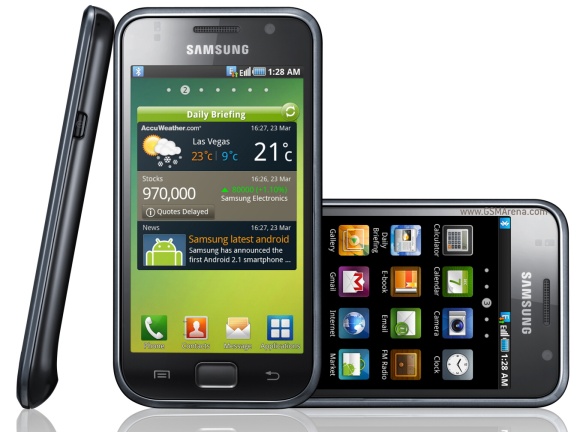
Samsung I9000 Galaxy S


Review of the characteristics of the Tablet "Smartphone"> "Tabphone" Samsung Galaxy Note
- Screen AMOLED Super 5.3''1280 x 800 pixels
- Connection: 3G +
- Stylus Pen S integrated
- 8 megapixel camera 2 megapixel webcam +
- Video recording at 1080p 24-30 fps
- Module A-GPS with digital compass
- NFC module (optional)
- Wi-Fi a / b / g / n Wi-Fi Bluetooth 3.0 + Direct
- Internal Memory: 16 / 32 GB + microSD memory card slot
- Samsung Processor 1.4 GHz dual core
- Ram: 1Ghz
- Audio output 3.5 mm jack
- RDS FM Radio Tuner
- Accelerometer, barometer, light sensor and proximity
- OS Android 2.3 + Gingerbread Samsung TouchWiz interface
- Dimensions: 146.85 x 82.95 x 9.65 mm 178 g


Design by Free WordPress Themes | Bloggerized by Lasantha - Premium Blogger Themes | Best WordPress Themes